Introduction
Even more after the pandemic, we are familiar with terms such as immunity or immune system. This concept emerged from the biological field and we could define it, in a general way, as the capacity of our organism to defend itself against any internal or external threat. It is therefore possible, pragmatic and necessary to speak of psychological and emotional immunity, as ways to prepare ourselves and improve our ability to face the challenges of everyday life.
This preparation could be helpful in the personal sphere, in the construction of our educational and work profile and in our dynamics at work, as well as in our interpersonal relationships -partners, parenting, friendships or family-, in our communities and social interactions and even in our search for vital meaning and our spirituality.
DET and Emotional Immunity
The Dynamic Emotional Theory -DET (Stefani, 2021)-, proposes that behavior is based on the emotional sphere –on what we feel-, which is itself articulated with the cognitive sphere -what we think- and is activated from the conduct sphere -what we actually do-. We know that the way in which we operate emotionally will determine our further psychological wellbeing.
One of the evidence of the influence that our primary emotional life has on our mental health is found in the Attachment theory. It is a scientific fact that an unsatisfactory early emotional attachment -visible in insecure attachment relationships- is predictive of future difficulties, not only in intellectual development, but particularly in the development of emotionally imbalanced interpersonal relationships later in youth and adulthood.
The correspondence between emotional and biological immunity can be also found in the analogy of the agent and the host in the dynamics of its interaction:
When we come into this world, our self (host) is at the mercy of a multitude of stimuli and demands that function as excitatory agents, both internal and external, such as sensations of hunger, cold, noise, smells or contact. All these sensations are going to be organized thanks to the interaction and attention given to the child by their caregivers (also called attachment figures in psychology).
In the early stages, our psyche considers those who give us care as mere «objects», which means we consider them in relation to our own needs. Other people exist -at this age- either to satisfy our desires, related to survival, or as obstacles to the achievement of those needs. In fact, many adult people remain fixated without further development stages of this emotional construction, as we see it in narcissistic (neurotically attached) and even psychopathic personalities.
Allow us to include here a brief parentheses to clarify and differentiate between neurosis, psychosis and psychopathy.
Neurotics always has a register of reality, but «overreacts» to it. Neurosis has different degrees of severity that will be determined by «how much» reality we are able to manage.
Psychotics, on the other hand, build a «parallel» reality that they live as real because the one they have is too painful for them.
Finally, psychopaths perceive reality, but ignore it because they are pathologically focused on their own needs.
In fact, how we establish our neurotic personality is closely linked to our first exercise or «practice field» of interaction in childhood, which has a strong primary accent on the self and the projections of all its material and also immaterial and affective needs. Little by little, and with difficulties on the way, we incorporate a more wider vision of the caregiver and from that primary link, with other people and objects in the world around us.
When the communication between the agent and the host -or between our psyche and the objects and people of the outside world- takes place, a learning process is generated from the experience. This learning condenses a huge amount of information, but of all this accumulation of data, what we register and store is essentially emotional information. The association between what happens and my emotional perception will build an enduring internal network that we will expand and associate with new and future situations.
Bowlby (John Bowlby, 1907-1990) refers to a model of mental representation – internal working model– that uses previous attachment information in future relationships. Pichon-Rivière (Enrique Pichon-Rivière, 1907-1977), for his part, proposes the conformation of an operative referential conceptual scheme, or (ECRO in spanish), which the psyche uses to categorize new situations.
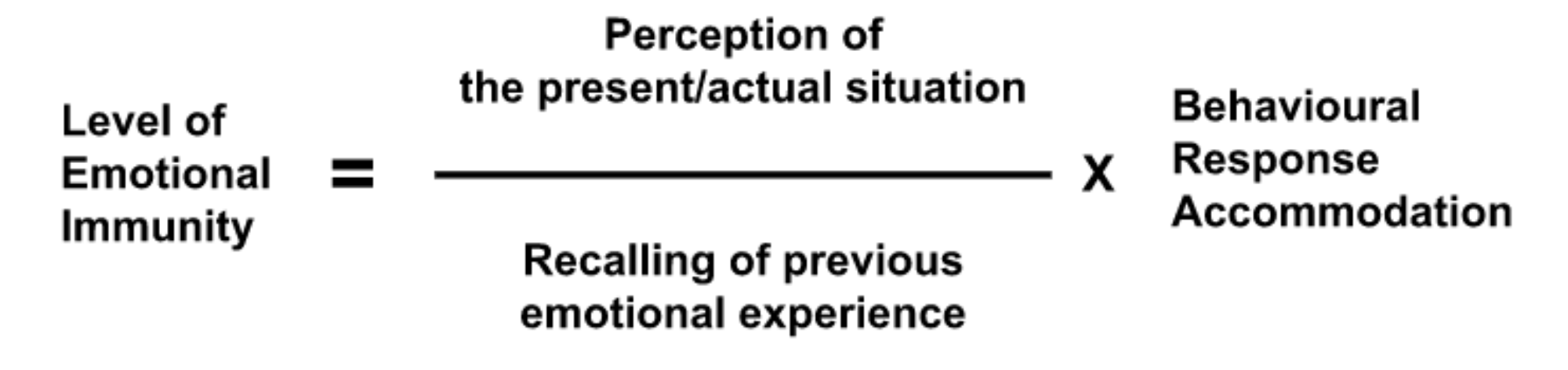
However, independently from the psychological theory we approach this phenomenon, what we can say is that all previous and significant registers will be used and operationalized in the current situation, therefore we propose the following formula:
What do we call emotional immunity?
It is the capacity to understand or resolve a situation that activates the internal emotional network in a highly functional way. Sensorial resistance is minimized and the accommodation and assimilation of new information is maximized, facilitating learning from a (more) neutral position.
Due to the fact that lower levels of emotional distortion occur when the higher emotional immunity we perceive, this results in an increase of communicative quality and openness.
Therefore, emotional immunity is not related to avoid responding emotionally to stimuli, but rather the opposite:
– Putting in place the activated emotional contents at the service of emotional management
– Expanding the conscious perceptual deployment of these contents, and
– Articulating the internal and external recognition of emotional communication.
Several authors have treated various forms of emotional communication since Sigmund Freud with his concept of transference and countertransference, or Carl Jung around the idea of collective unconscious or more recently as social intelligence, as treated by neuroscience.
To develop or increase emotional immunity in terms of complexity, amplitude or speed, we must first go from the registration of emotional evocation to the perception of the current situation. Then we can establish a relationship between the two that results in a functional, satisfactory and healthy behavioral response.
In short, emotional immunity implies that we possess the ability to:
(a) recognize the emotional need that an interpersonal or intrapersonal interaction, or situation requires.
(b) register the perceived emotions that have been summoned by that interaction or situation.
(c) process the information in relation to the type of interaction desired.
(d) assess and execute a satisfactory behavioral response.
Therefore, Conscious Breathing and sensory activation are fundamental to manage these processes.
Transcending personal emotional immunity
In conclusion, emotional immunity is not itself empathy. For example, there may be a group of ten highly emotionally immune people in the same room who, nevertheless, have not learned or developed the ability to bond emotionally with others.
This is why we say that emotional immunity is a necessary but not completely sufficient condition for empathetic interactions to occur, whether they are natural or intentional.
Natural empathetic interactions will be simpler, since we tend to easily generate a natural emotional connection response when a person «likes» us, evoking pleasant emotions. On the other hand, to produce an intentional interaction with those who are «unpleasant» to us, we must make an effort to bring emotional immunity into play, allowing us an effective and healthy relationship dynamic.
Finally, to transcend from the individual to the family and the community, we should not only promote emotional immunity in individuals, but also foster spaces of collective emotional health in order to solidify sustainable and emotionally healthy social development.
Viola Edward
Founder/CEO of GRIT Academy. Multi-awarded personal & corporate advisor/Mentor. A Transcultural Psychotherapist, Mentoring, Coaching & Breathwork Trainer. Humanitarian, Social Entrepreneur, International Speaker & Connector, Philanthropist.
Partner/ED of Creative Women Platform, Co-creator of BQ – Breath Intelligence and GRIT Method.
Committed to the creation of a sustainable society since 1993, the author of 2 books, one is Amazon Best Seller and co-author of 13 more.
Sits on the board of several institutions and serves as Ambassador for Human Rights.
Saxa Stefani
Psychologist with Master in Education and Scientific Researcher.
Author, currently living and working in London, Stefani had the privilege to work in different areas of psychology: clinical psychology, therapeutic mentoring, human resources, psychiatric and addictions treatment institutions, and education.
Founder of ceideps (2011), a center specialized in Social Psychology, that he describes as «one of the most powerful tools in psychology to accomplish a deep and multidimensional understanding and management of human behaviour for individuals, groups and organisations».
* Article published in Executive Women (Sep 2022)